
Leicestershire's retiring Chief Constable Rob Nixon reflects on his most memorable case, possible crisis and future of crime as he leaves policing
After more than three decades of fighting crime in Leicestershire, Chief Constable Rob Nixon retired on Friday, March 28.
Mr Nixon took on the role – the highest post an officer can hold in Leicestershire Police – in March 2022, following the retirement of Simon Cole.
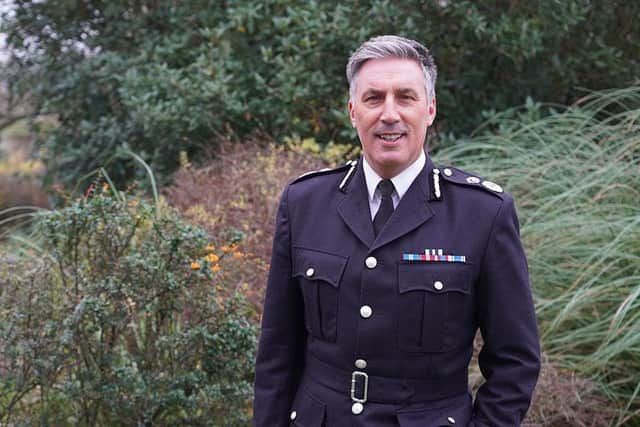

His departure will bring to an end his 32-year policing career, which the force said had been “defined by a commitment to service, innovation and collaboration”. Leicestershire Police itself, the nature of crimes and the challenges of policing have changed hugely in that time, Mr Nixon told the LDRS, in an interview at force headquarters in Enderby.
In recent years alone, he has had a leading role in the local Covid-19 response, in policing the 2022 disorder in the city, which saw days of violence break out in east Leicester following the conclusion of an India v Pakistan cricket match and in the country’s prison crisis. The LDRS sat down with the outgoing chief constable to ask him about his most memorable moments on the force, the biggest challenges facing policing today and the changing face of crime.
Most memorable case
Mr Nixon described his career as being “very varied, interesting and, sometimes, challenging”. As a detective, he said, he was involved in crimes ranging from “homicide to kidnaps to some fairly horrific crimes”.
Perhaps the “most complex” were the various incidents of mass unrest that have rocked the city over the past decade and a half. Leicester saw incidents of disorder in 2010, 2011, 2012 and most recently in 2022. They were all “very challenging types of incidents”, he said, and result in other crimes “that spin off from them”.
However, there was one crime in particular that stood out for him from over his three decades of policing – an allegation of the rape of a woman by her partner. Mr Nixon said: “I always remember this lady being phenomenally bright, and she suffered this sort of torturous relationship […].
“The partner put forward a fictitious account, total victim blaming, and I remember using a pathologist to prove the injuries [he had inflicted on the victim] had been caused more consistently with what the victim said than what the offender had been suggesting had happened. As a consequence of that, he was convicted and went to prison and she got her life back.”
Mr Nixon added: “It was just a fairly routine type crime in terms of what got reported, but, if you actually think about the suffering that that person was under, the fact that thinking differently and using using a pathologist on somebody who was living rather than somebody who was dead, and then how that got played out to the trial, I think that was a fairly significant investigation.”
Trust in policing
Following a number high-profile crimes by serving officers, there is a national discourse around a weakened trust in policing. We asked Mr Nixon whether he recognised that potential lack of trust.
He said: “Those cases are absolutely outrageous, and I don’t think you will ever find police officers who would try to defend that. I think we have to remind ourselves is, one, we never tolerate it, we strive for the highest possible standards.
“But, at the same time, let’s not forget that what I see probably 98-99 per cent of the time is people who come to work to do an absolutely sterling job to serve the communities and they’re good people. These are good people that put their lives at risk.”
By focusing on the negative and not celebrating officers’ hard work, Mr Nixon said, he believes that we could be heading for “a major problem” in policing. He added: “We will find ourselves in a position where people don’t volunteer to do [the job].
“There are many, many officers who feel that the job is very, very demanding, very tricky, very challenging, and they’re not recompensed either financially or through the support from the public […] That worries me.
“It worries me because I do genuinely believe that we have some really, really good people and when they start to vote with their feet and say it’s not worth it anymore, that’s where we’ve got a major problem.”
Public comments often include concerns over a lack of visible policing in communities. We asked Mr Nixon if he believed that having more ‘bobbies on the beat’ could go some way towards improving community confidence.
He said: “Back in the ’90s, [crime] was all ‘what was visible and on the street’. Now you’ve got what’s invisible – hidden crime, safeguarding and cyber crime.
“We need to do all of that mission, so we’re visible in the right places. We’re preventative in cyberspace and we’re responsive to where there is online crime. We need to deliver all of that within the finite number of resources that we’ve got.
“Do I think we will get to a position where we’ve got police on every street corner? Not unless there’s massive investment in policing.
“What I think we are starting to do, which I think is probably the good thing, is being really, really efficient and making sure that officers are in the right place at the right time. A smarter, more intelligence informed patrol strategy feels like a better way to optimise resources than just a blanket ‘can we have more officers on the streets’.”
New challenges
The number of crimes forces have to deal with has doubled since Mr Nixon started policing in 1993, he said. Crimes have also “significantly” increased in complexity, with the rise of technology bringing about new offences.
“We’ve seen the explosion [of technology], which has led to technology that [has] enabled crime – online crime, stalking, harassment,” said Mr Nixon. “You’ve seen organised crime, from global to local, and you’ve seen in the middle of that a whole explosion of safeguarding requirements.”
Technology has also brought with it other challenges, Mr Nixon said he believed. Those were exemplified during the 2022 city disorder, he said.
“If there’s tension and it’s then being fuelled by social media, you end up with quite a challenging set of circumstances. I think this is the new norm, isn’t it?
“Social media will pick up and amplify things very quickly. You end up with people adding an opinion from outside of the area, and often that opinion is ill-informed, not factually accurate, and that can be really unhelpful.”
Mr Nixon said that because of that, he believed the police also needed to work online to get “trustworthy” information out to the public, including by collaborating with the Press and influential community figures.
Public engagement with policing has also “shifted”, Mr Nixon said he believed. There was more of a “sense of entitlement” now, he said, and people’s level of tolerance had decreased. This had led to a “24/7” culture with people “expecting an instant response”.
“Being able to manage expectations, I think, is a challenge not just that policing will suffer, but I think every business will suffer,” said Mr Nixon. “If [managing expectations] isn’t successful, you might end up with the same information coming in via multiple channels, via a social media platform, for example, as well as email, as well as letter. It’s the same thing, but what it does is it duplicates the correspondence [needing to be dealt with].”
Looking forward
Funding is one of the main challenges facing policing as it looks ahead, Mr Nixon said he believed. He said there was a “resource shortfall” in policing which, when coupled with the “expanded mission”, was creating a “capacity gap”.
Leicestershire Police has been making efficiency savings for 15 years, he added, but spending cuts and further reductions in the coming years were “likely”. He said he hoped that reformed ways of working, through more automation and a greater role for technology, would help bridge the gap.
If that does not, however, Mr Nixon said he was concerned that the financial difficulties would result in a “need to reduce services”. He added: “I think there needs to be a reality check of [the fact that] we’re 15 years into ‘let’s do more with less’. So you are really into that territory [of] you’ve either got to stop doing it or you’ve got to automate it. They’re the only ways you’re going to close that capacity gap.”
Mr Nixon said he believed his successor – who is yet to be announced – would have around a year before financial pressures really started to mount. His advice to whoever gets the role is that they should be thinking “very early on” about how they are going to tackle that problem, and how they will bring the public along with them if service changes are needed.
Other challenges for the force include the lack of space in prisons across the country. Mr Nixon has led on Government attempts to try to resolve the prisons crisis, including the early release of some prisoners. The issue brings its own concerns for forces, he said.
“When people aren’t in prison or they’re given an alternative [sentence], we’ve got to be really clear that it’s a really robust management […]. You can’t see that risk being passed back onto the police. If people are in the community and they’re not in prison, then there’s a greater risk of further offending. Those people that are in the communities need to receive effective offender management.” The Probation Service, and not police officers, supervises offenders serving community sentences or who have been released into the community from prison.
Mr Nixon said: “There needs to be good levels of scrutiny around compliance, and where there’s non-compliance, there’s swift justice putting them back into the criminal justice system.”
One last message
We asked the outgoing chief if he had one final message for the Leicestershire public and his colleagues. He said: “My message is one of thanks as I leave the organization after 32 years.
“I’ve got so many good memories. The thing about policing is everybody’s fixated on the negative.
“Actually, I look at it and I think I have had the privilege of helping so many people over 32 years. I have categorically shaped and influenced people’s lives to the positive. I take great pride in the fact there are many people, the silent majorities [as] I refer to them, that will probably look on and think I did a good job.
“My message to them is thank you for their support. Thank you for the friendship I’ve received from so many different people, so many different communities over the years through so many difficult and challenging times, and I leave with so many fond memories of them.”