
Harborough district floods: Flooded villagers in Great Glen demand answers as they are unable to return home
To most people, January’s floods have become a distant memory, but for the residents of one Harborough district village their houses are a daily reminder of the devastation.
In Great Glen, many homes have been ruined by the floods and five weeks on from the rising water many are still unable to return home.
The Local Democracy Reporting Service (LDRS) went to Great Glen to speak to those impacted, with many there demanding answers as to why the village was so badly affected. The floods on Monday January 6 left 55 homes flooded – that’s compared to just five homes the previous year when Storm Henk hit the UK.
Many in Great Glen have still not moved back into their properties following the floods. Among them is Susan and Gurdip Bains whose house in the village’s Main Street is now home to the low humming sound of several large dehumidifiers. Susan said: “We had over two foot [of rain] that came into our property.
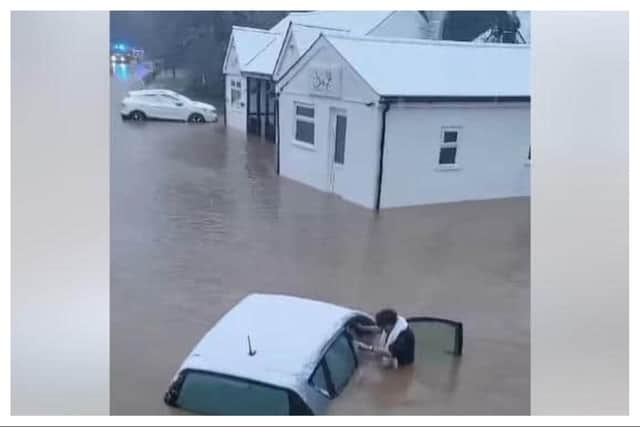

“I had just got up [at 7.30am] and I looked out of the upstairs window first. I thought no – because it was really high actually – and then I thought, let me just go downstairs. It was flooded up to the first two steps, so I couldn’t get down the stairs and all our Wellingtons and boots and everything were downstairs.
“My husband had to go in the water and it was dirty, contaminated water. So he put his wet Wellingtons on, and walked down to my daughter’s around the corner. Two of the cars were flooded in the driveway. Obviously, when something like this happens, you’re quite lost and don’t know what to do. We just looked at each other and said, what do we do? Where do we go? Who are we supposed to tell?”
The situation was so bad that Susan needed to put plastic bags on her feet before finding her wellies and making her way to her daughter’s. Upon her return home after the water began to recede, the Bains were left the sight of contaminated water in their downstairs, while power was off too.
She said: “We were just left with all contaminated water downstairs. Everything was just soaking wet. After the water’s gone, you see the damage that has actually happened and everything. And then by the afternoon, I said to my husband, ‘where are we supposed to stay?'”
The answer has been a Premier Inn for the best part of a month, but now the Bains’ are renting a temporary home for six months as their house simply isn’t safe enough. Susan, 59, said: “It was getting so depressing [staying in a hotel] we had to find food every evening, and we can’t cook there and when you’re eating out, you can imagine it’s costly. So [now that we’ve moved into the rented house] I just did a big shop yesterday and put it all in the fridge.”
Fellow villager Andy Smith lives just up the road near the Italian Greyhound Pub on London Road which was badly hit by the bloods. Andy’s home is hundreds of years old, but had suffered no flooding until last year. Now it has been hit twice in 12 months.
The 67-year-old said: “My home was built in 1610. When we bought it in 2014, there were no records of it flooding. It flooded originally on Tuesday, January 2, 2024 [we had everything replaced]. We were due to move back in the week after [the latest flood]. So we hadn’t actually used anything.
“Everything [downstairs] was new, the kitchen was new, well, now it’s been ripped out again, and we’ve not even been back”.
We took a walk up to Andy’s house. The same familiar sound of dehumidifiers could be heard. Brand new flooring that had been laid since the last floods had been ripped out, the never-used kitchen had been removed and the appliances, including a brand new aga and fridge freezer – still with the labels on, were covered in silt. All the rooms were ruined with brand new fixtures and fittings all destroyed by the floods.
Mel Davis is the spokesperson for the flooded neighbours and said everyone wants answers as to how the devastation happened in the way it did. She said everyone wanted to know what steps were being taken to ensure nothing like this happens again.
Neighbours in the village say they want the authorities to explain why the floods were so bad this year. Last week, when the LDRS went to visit them, they still looked in a state of shock. People living near the brook, including Andy and neighbour Mel, said they had invested in 450 sandbags at a cost of £2,000 but that did not stop the water from getting into many of the properties.
On the day of the visit, the silt levels in the brook were extremely high and the silt on the pavements was very slippery. Homeowners claim that the brook started flooding two years ago and that the drains were never cleaned, while ones in the village’s London Road had been tarmacked over.
Great Glen residents said there had been no investment in the village to protect them from flooding, and felt that January’s widespread devastation could have been prevented if the authorities had listened to them after the likes of Mel had raised the issue previously.
Councillor Ozzy O’Shea, lead member for highways and transport at Leicestershire County Council, said the council’s thoughts remained with those affected. He said: “We understand that the rainfall was much greater in quantity than storm Henk and over a more confined period overnight. This coupled with a large amount of water volume with the snow melt on already saturated ground led to record river levels, excessive water run-off and overwhelmed systems, which sadly flooded many roads, local communities and properties across the county.
“There are multiple flood locations across Leicestershire, and as Lead Local Flooding Authority, we want to reassure residents we are working with partners to investigate them all, including Great Glen. However, it’s still too early to establish the cause on any one incident. Once investigations have taken place and where an issue can be identified, it will be for the relevant agency to address and progress any solutions forward.”
Coun O’Shea said the council is continuing to lobby the government for flooding to better protect communities, but funds to help those impacted in January had yet to be activated. He said highways drains were also cleaned on a “cyclical basis” depending on how frequently they fill with silt. He added that the council will investigate any “specific concerns raised about gullies”.
An Environment Agency spokesperson said it was working with the county council to protect the village and a drop-in event for affected residents will be held in due course. They said: “There are existing flood defences in Great Glen, which have prevented flooding on many occasions. However, given the scale of the event this January and Storm Henk in 2024, the defences were overwhelmed.
“Our understanding is that there was also surface water flooding in the village, which the flood defences would be unable to prevent. People should check their flood risk, sign up for free flood warnings and keep up to date with the latest situation at “check-for-flooding.gov.uk.”
Kirsty Haynes, catchment lead at Severn Trent, said there were “no concerns” about the network capacity around Great Glen despite the floods. She said: “We have no concerns regarding the capacity of the local network around Great Glen to handle water under normal conditions. However, extreme weather events such as these are becoming more common, and we are reviewing the capacity of our networks to ensure that they are able to meet both current and future demand.
“While Severn Trent can assist with issues relating to blockages in our underground network, issues relating to flooding from a watercourse sit with either the Lead Local Flood Authority or Environment Agency. The local highways department is responsible for the maintenance of the roadside surface water drains.”