
Approval given to build on site of ancient monument near Hallaton
Approval has been given for a nine-metre high structure in the setting of an ancient monument near Hallaton, despite residents warning that now the “floodgates will open” on planning decisions.
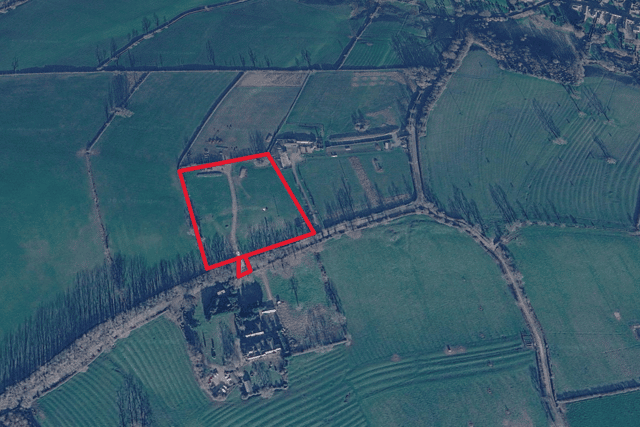
Simon Laird put forward the partly retrospective plans to build an agricultural shed plus a farm track and yard at Monument Farm, Cranoe Road, which were discussed at Harborough District Council’s planning committee.
Documents note that part of the site falls within a designated scheduled monument, which is described as an Iron Age and Roman ritual site. A further scheduled monument known as Hallaton Motte and Bailey is listed to the north of the site.
Neighbour Alice Measom spoke against the plans, saying residents’ objections had been misrepresented as a neighbour dispute, which was “not true”.

She said: “Assessed on its planning merits and evidence alone, this proposal is fundamentally failed.
“The key question is simple. Is this required for agriculture? It is not.”
Ms Measom said the site “gained the highest level of statutory protection as a scheduled monument” in 2024. Then, she added, without planning permission or consent, [Mr Laird] “turned grazing fields into a secured serviced operational compound”.
“This is not a modest barn required for agriculture,” she continued. “It’s a development by convenience, followed by an enforcement-led attempt to justify and legitimise it retrospectively as agricultural.
Addressing the planning committee, she said: “Please do not approve this merely to close a controversial enforcement case. Approval will set a profoundly damaging precedent.
“Develop first, wherever you choose, without permission, outwait enforcement, and construct something without forgiveness.
“The floodgates will open”.
Mr Laird’s application states that the proposed development is for agricultural purposes, including housing cattle and sheep, rearing young calves, storing feed including hay and straw, use as a shelter for machinery and veterinary handling.
The barn would be a single-storey steel structure, “typical of modern agricultural development”, the plans add.
Robert Waite, who introduced himself as a planning lawyer and a specialist in planning and related areas of law, including heritage, said: “Members can see from the report how prominent visually this site is in landscape terms.
“It’s described as a modest building, I think, by the officers, but its footprint is 465 square meters, isn’t it?
“Just doing the arithmetic there, it’s effectively going to be nine metres high, allowing for the constructive development platform that [the planners] mentioned”.
Harry Fowler, speaking on behalf of Mr Laird’s application, described the application as “fairly straightforward”.
Mr Fowler said: “I think there’s a lot of concerns, some justified, but I think what I want to try and do is separate the relevant facts from potentially the noise.
“The applicant owns 25 cattle, 40 sheep. I’ve been down to site seeing the cattle. I understand most of you probably have as well if you’ve been on-site.
“They’re lawfully kept on site for agricultural purposes and ultimately the barn is there to protect the cattle, mainly in the depths of winter. It’s in compliance with animal welfare regulations.
“Again, heritage is the key important fact in my opinion. Without going into all the details again, we know that county archaeology and Historic England originally raised concerns back in December.
“They wanted further visual impact assessments, archaeological work, further trenching, clearer marking of the monument boundary, more detail of landscape, hard standing earthwork to understand how deep down some of the work was going.
“That was all provided, and as of May, both county archaeology and Historic England confirmed they have no objections, and that, in my opinion, is very important.”
Mr Fowler then spoke about “other concerns” that had been raised, including scaffolding. He said: “As we know, the applicant owns a scaffolding business up in Billesdon. There’s some concerns that he’ll use the site for this purpose.
“What I want to say is that at the moment the site is agricultural as it stands, should he use it for that purpose, which he has not, he would be open to enforcement action.
“Whether this is approved or refused tonight, that won’t change. He would still be open to enforcement if he were to do that.
“Either way, scaffolding storage is not allowed, and there’s been no evidence of it so far.
“And going into aspects with trouble with the neighbors, I understand there’s a long-running issue there.
“Most of those factors are obviously not relevant to planning, so I wouldn’t want to get tied down into them, but I do fear that that has led to a slightly scattergun approach to some objections which hasn’t been productive for the planning purpose, really.
“In a nutshell, the applicant has satisfied all of the technical experts and the planners”.
The application, which was put forward for approval by planning officers, was approved with five votes for, one against and two abstentions.