
Harborough District Council planners back application on 'one of the most significant Iron Age discoveries in Britain'
An application has been submitted on the site of “one of the most significant Iron Age discoveries in Britain”.
The application, which has had 19 objections raised against it, as well as an objection from the parish council, is set to be approved by Harborough District Council (HDC) planning officials next week.
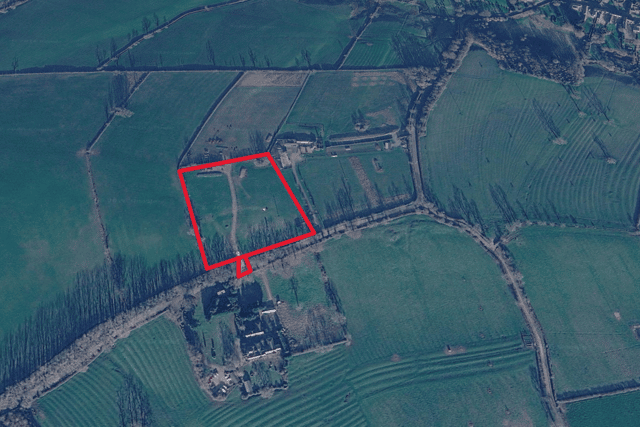

Mr Simon Laird has put forward the plans, which are partly retrospective, to build an agricultural shed plus a farm track and yard at Monument Farm, Cranoe Road, in Hallaton.
The application is due to be discussed at Harborough District Council’s (HDC) planning committee meeting on Tuesday, June 16.
Documents note that part of the site falls within a designated scheduled monument, which is described as an Iron Age and Roman ritual site.
To the north of this, they add, is a further scheduled monument described as Hallaton Motte and Bailey.
The plans were initially submitted in October last year. Subsequent amended plans have been submitted between November to May.
Mr Laird’s application notes that the proposed development is for agricultural purposes, including housing cattle and sheep, rearing young calves, storing feed including hay and straw, use as a shelter for machinery and veterinary handling.
The barn would be a single-storey steel structure, “typical of modern agricultural development”, the plans add.
The application notes: “The Hallaton Motte and Bailey is a Scheduled Monument of high national importance. However, the proposed agricultural barn at Hare Pie Farm is located over 600 metres away, beyond Hallaton village, on a previously developed agricultural site with no intervisibility or physical connection to the monument.”
Documents state that no new access points would be required, as the existing farm entrance on Cranoe Road would be used.
But the plans have proven controversial, with many residents opposing them.
One said: “The proposal is entirely without lawful, viable or policy-compliant justification and fails in every material planning respect.
“The complete absence of any evidenced agricultural need is fatal to the application and removes any possible basis for supporting agricultural development on this land.
“The creation of a new and isolated agricultural enterprise in the open countryside is fundamentally contrary to national and local planning policy; the site lies below the permitted development threshold, is incapable of sustaining the agricultural operations claimed, and is further constrained by the statutory protections arising from its Scheduled Monument designation, rendering the development wholly inappropriate”
Another said: “I object in the strongest terms. This application is incapable of lawful approval because the applicant has provided no evidence whatsoever of any agricultural enterprise or operational need.
“Even if agriculture existed (it does not), the building is not designed for livestock. The plans contain no pens, no feed passages, no slurry storage, no drainage, no ventilation strategy, no welfare layout, and no handling facilities.
“It is a fully enclosed, industrial-style shed identical to the applicant’s previous storage buildings. A building with no livestock infrastructure is not an agricultural building.”
While a third said: “I am a long-standing resident of Hallaton and involved in the study and preservation of its nationally important historic landscape.
“The application site contains part of the Scheduled Monument associated with the Hallaton Treasure, one of the most significant Iron Age discoveries in Britain. I object in the strongest possible terms.
“The Hallaton Treasure, discovered in 2000, is a crucial aspect of our history and culture and, as such, it is irreplaceable. The continued damage done to the site where the excavation took place is very distressing and breaches the requirements of the Heritage Monument.”
During consultation, planning enforcement wrote to acknowledge it had been involved with the land “from an enforcement perspective” since 2021.
It added: “The landowner experienced issues getting the land put into his name. Once this had been resolved we became involved again [in 2024] when we received reports of works taking place within the Scheduled Ancient Monument.
“A Temporary Stop Notice was served on 26th September 2024 and the enforcement team has regularly monitored since then.”
Following subsequent updates to the application, HDC planning officers have concluded the proposed agricultural building is “acceptable in principle in the countryside”.
They state: “Its siting and design do not adversely affect the rural area including the local landscape designation and important local viewpoints. It does not adversely affect residential amenity and highway safety.
“As identified by Historic England there is a low level of less than substantial harm associated with the development as proposed.
“This less than substantial harm is balanced with the public benefits of a better defined and controlled space benefiting the effective management of the scheduled monument.
“Whilst limited, these benefits are proportionate to the limited adverse impacts of the proposal. Therefore, the low level of harm does not represent a proper reason for the refusal of planning permission.
“The proposal accords with Development Plan policy and there are no material considerations warranting a decision other than in accordance with the Development Plan. Planning permission should therefore be granted.”